




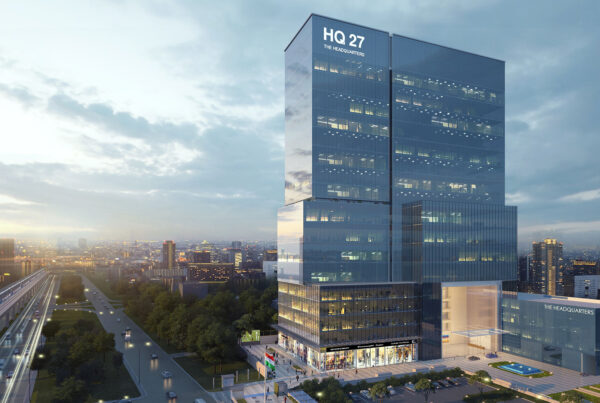
Post-Covid, the rules governing commercial real estate have changed. Work patterns have shifted, employee expectations have risen, and businesses are recalibrating how much space they need and what that space must deliver. The central question is no longer how large an office should be, but whether it is worth the commute at all.
India’s commercial market remains one of the strongest in Asia. Over 50 million sq. ft. of office space was leased in 2023 alone, led by Bengaluru, Hyderabad, Mumbai, and Gurugram. Yet most large occupiers have settled into hybrid models, with employees in office two to three days a week. In that context, space is no longer measured by area. It is measured by performance.
Flexibility as Infrastructure
The regimented workstation floor is giving way to something more considered. Tenants now require spaces that can be reconfigured without structural intervention — meeting rooms that expand or contract, collaboration zones that replace underused formal areas, floorplates that can evolve as teams do. Adaptability has become a leasing criterion.
Well-being as a Baseline, Not a Benefit
Access to natural light has been shown to improve employee productivity by up to 15%. Air quality is directly linked to cognitive performance. What were once premium features—efficient ventilation, touchless entry systems, air quality monitoring, outdoor terraces—are now standard expectations. Developers who treat wellness as an afterthought are building for a market that no longer exists.
Energy Efficiency as a Financial Argument
Commercial buildings account for 30–40% of total energy consumption in urban India. With electricity costs rising and ESG commitments tightening, energy performance has moved from aspiration to acquisition criterion. Efficient façades, LED systems, water recycling, and solar integration now directly influence leasing decisions. The financial case is straightforward: lower operational costs improve tenant retention and asset stability over time.
Location Reconsidered
Address alone no longer determines desirability. Offices integrated with metro networks and major transit corridors consistently outperform on demand and occupancy, particularly in emerging business districts such as Noida and Pune, where proximity to public transport is reshaping both leasing behaviour and long-term asset value.
The Buildings That Will Lead
The commercial tower of the next decade will not be defined by its skyline presence alone but rather by how reliably it performs for tenants managing hybrid workforces, for organisations with energy and ESG targets, and for employees who have come to expect more from the places they choose to spend their time. The question is not whether the office has a future. It is whether a given building is prepared for it.